
Not So Clear: Tackling Septic System Contamination
By Sophie Garrote, Environmental Science and Terrestrial Resource Management ‘26
Every day you wash the dishes, take a shower, and flush the toilet. But do you know what happens to that water after you use it?
If you live in a city it’s likely your household is connected to a main sewer. Alternatively, 1 in every 5 households in the U.S. run on a septic system. How they work is not for the faint of heart!
Solids and greases are separated out of sewage in a tank, while the remaining liquid, called effluent, is piped into a gravel drainfield. As it seeps into the soil below, it is treated by microbes before percolating into groundwater. Due to the buildup of solids in the septic tank, they must be pumped regularly to prevent clogs in the drainage field forcing untreated sewage into groundwater.
It was previously believed that septic systems over 50 years old were more prone to failure, however, a University of Georgia survey found that 2- to 10-year-old systems were just as likely as 50-year-old systems to experience hydraulic failure. A dangerous lack of monitoring and maintenance of newer septic systems increases the risk of environmental consequences.
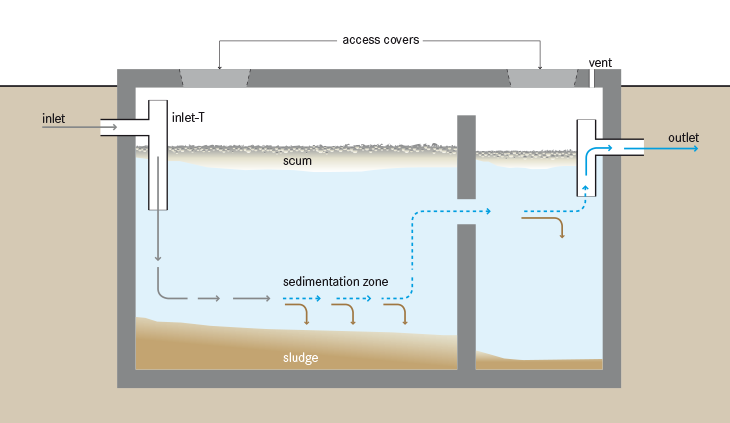
Diagram illustrating the flow and separation of sewage through a septic tank. Photo by Sustainable Sanitation and Water Management Toolbox.
But what difference would some sewage in our lakes and rivers make? Take Lake Washington, for example, a waterway in our own backyard that was once plagued by repeated dumping of sewage.
From the 1940s to 1960s depositing secondary treated sewage in Lake Washington was common practice. Excess nutrients, like phosphorus, contributed to eutrophication, where large algae blooms reduce oxygen in water, causing large fish die-offs and complex food web changes.
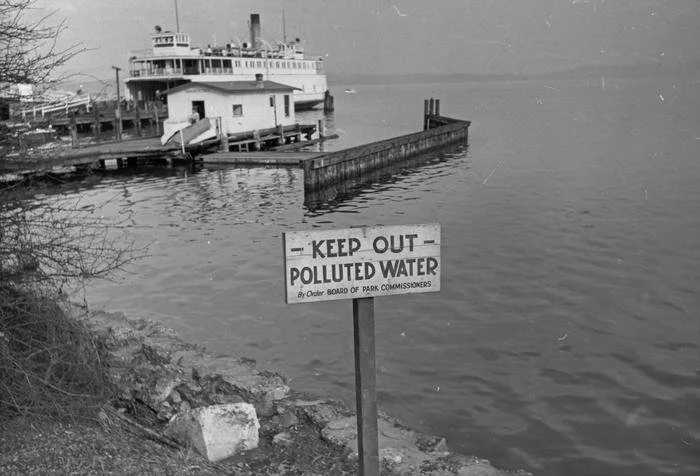
A sign in Seattle’s Leschi Park, which borders Lake Washington, taken in the 1940s. Photo from Seattle Municipal Archives (Identifier #29663).
However, the sewage in this case study was treated. In contrast, the effluent leaked from septic tanks is not and may contain contaminants like pathogens, pharmaceuticals, and more. Pharmaceuticals, like synthetic estrogens, are detrimental to the reproductive health of aquatic animals, with some fisheries reporting a higher ratio of female-to-male fish contributing to population declines.
Despite Seattle’s central sewer system, there is still risk of waterway contamination with septic effluent. Effluent from one of the 85,000 septic systems in King County could enter groundwater and move to surface flows, disrupting ecosystem functions.
The solution to Lake Washington’s problem was simple: divert the sewage elsewhere. But with septic systems, debates persist about how to tackle contamination and maintenance. Take the communities of Whitefish and Flathead Lake in Montana, for example. Recreational activities in their sparklingly clear waterways are essential for the local economy, bringing in $107 million in tourist revenue.
Despite the economic dependence on a healthy lake, residents are wary of connecting their households to a city sewer system for fear of increasing property taxes. And yet, many people are responsive to paying for regular maintenance or replacement when shown that the effluent was coming directly from their own systems through synthetic DNA tracers.
Being informed about where your sewage ends up benefits the function of your own home and goes a long way in maintaining the natural resources around you. “Out of sight, out of mind” can be wishful thinking, when what we flush down the drain only resurfaces as a bigger problem.