
Protection from Peril: Securing a Future for the Southern Resident Killer Whales
By Ashley Ingalsbe, Environmental Studies ‘27
For millennia, Southern Resident Orcas could be found frequenting the nearshore waters of the Salish Sea, following ancient Chinook salmon runs from the Snake River through the Pacific Ocean. The same cannot be said for today.
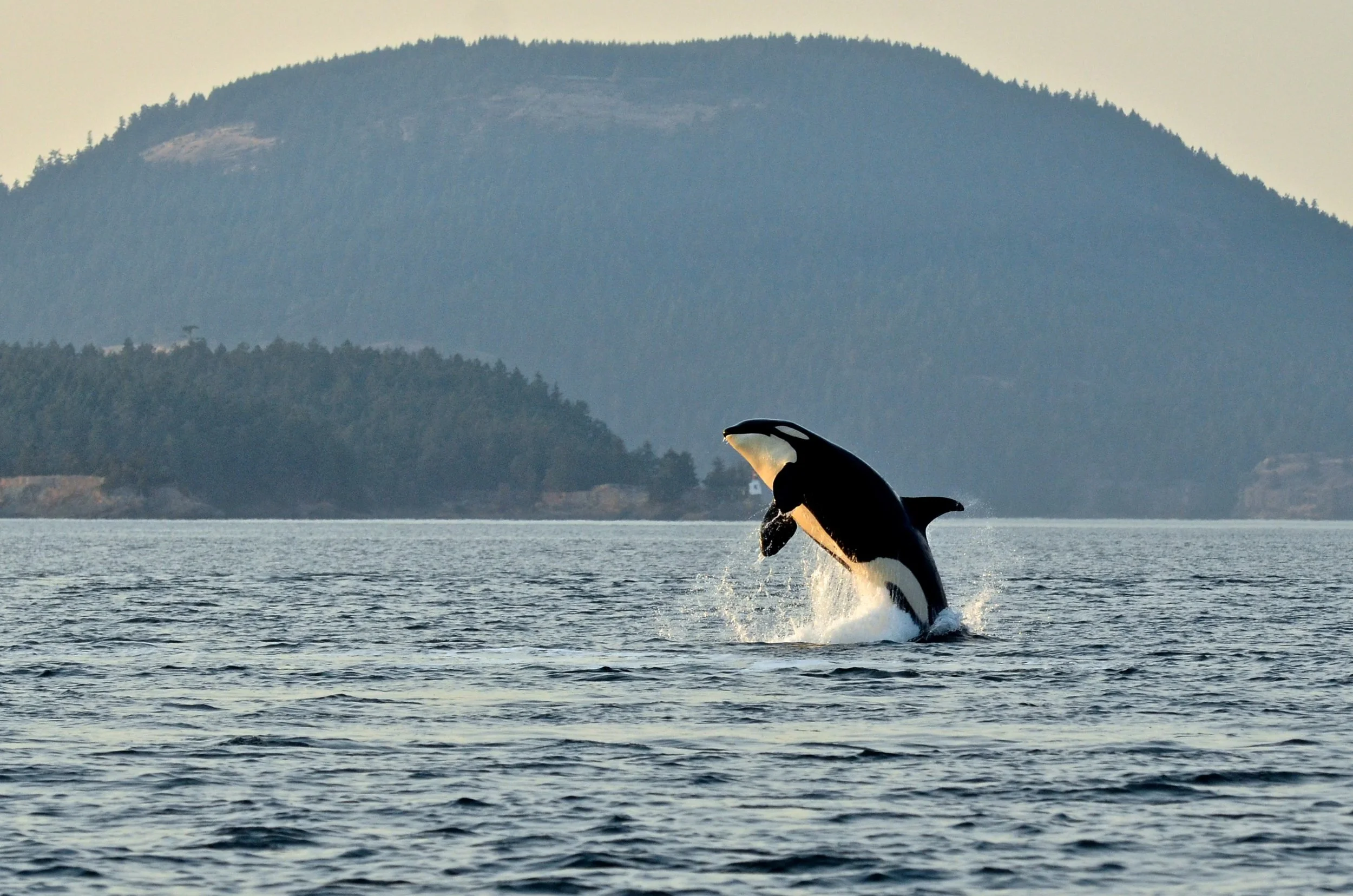
Big orca breach. Photo from Flickr, fuji.tim.
The Southern Resident community consists of three matriarchal pods designated by researchers, known as “J, K, and L,” who each share their own unique language and cultural dialects. Throughout history, these socially adept and intelligent creatures have sustained deep cultural ties to the Puget Sound and Coast Salish people. In recent decades, these connections have been weakened by mounting human impacts to the environment that hinder the Southern Resident’s ability to hunt, feed, and reproduce.
After nearly 40 years of extensive study, three major threats to their population have been identified: reduced prey availability, toxic pollutants, and vessel and noise disturbance.
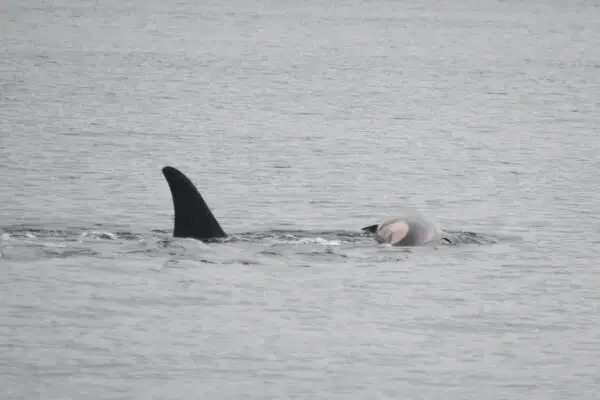
Southern Resident, Tahlequah, carrying another deceased calf, 7 years later. Photo by NOAA Fisheries.
Perhaps the largest threat to Southern Resident Orcas is the decline of Chinook salmon, driven in part by dams that limit upstream spawning runs of adults and downstream outmigration of smolts to the ocean. By some estimates, removing the Snake River dams could return nearly one million salmon to the Pacific each year. Moreover, noise pollution from vessels and aircrafts also inhibit the orca’s ability to echolocate and find prey.
Soundwatch is an organization in Friday Harbor that seeks to protect the Southern Residents by working to reduce vessel disturbance in the Salish Sea. “Working for Soundwatch and the Whale Museum has been one of the most fulfilling experiences I’ve ever had,” said Aly Liu, a UW Marine Biology graduate and former Soundwatch intern. “It’s one piece of a mosaic of collective action, and it just goes to show how far a grassroots community effort can go.”
Soundwatch monitors marine protected areas and collects data on vessel and whale behavior, all while aiming to educate boaters on best practices to preserve marine wildlife. Following the 2025 regulations requiring boaters to remain at least 1,000 yards away from Southern Resident killer whales, the outlook for the population appears increasingly hopeful.
“We can couple whale behavior with boat data to see how human activity is impacting whales,” added Liu. “Since we began collecting data, the number of vessels observed with whales has gone down.”
Beyond public education and grassroots monitoring, long term scientific research plays an invaluable role in protecting and understanding the Southern Residents. Deborah Giles, killer whale scientist at SeaDoc Society and resident scientist at UW Friday Harbor Laboratories, has dedicated the majority of her life to translational science and field research on Southern Residents.
“To see them in the wild was just an amazing experience,” said Giles, recalling her first encounter with the whales at just 18 years old. “They just got in my heart and my brain.”
Alongside her whale poop-sniffing dog, Eba, Giles uses a non-invasive approach to collect fecal samples, analyzing toxic contaminants and stress hormones in the whales. “Pretty much anything that you can learn from a blood sample in a human, you can learn from a fecal sample in a whale,” said Giles.
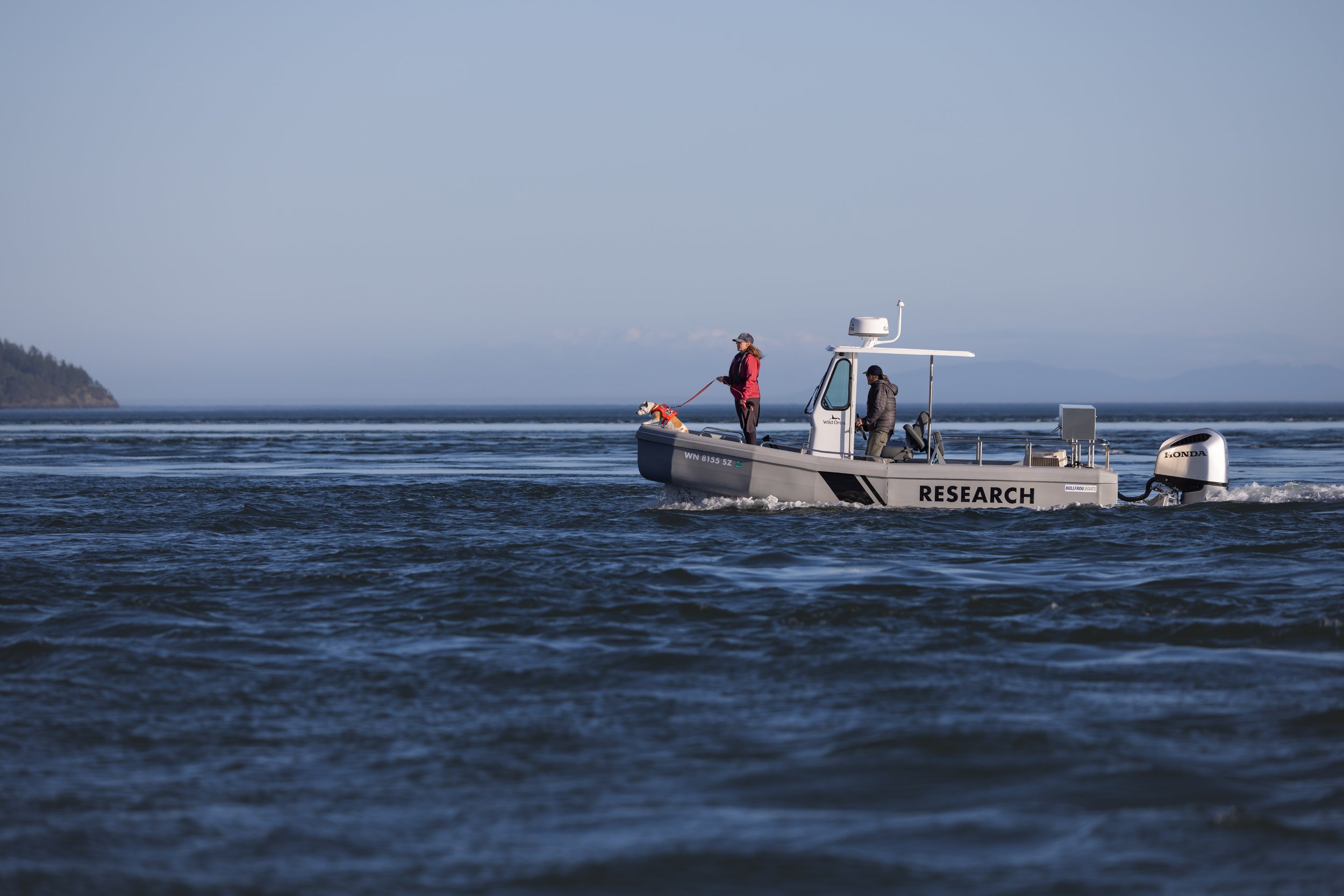
Giles and Eba. Photo by The SeaDoc Society.
Ultimately, grassroots advocacy, targeted campaigns, and conservation legislation have contributed to the development of protective measures for Southern Residents, and the early implementation of such policies have begun to mitigate threats and support coordinated recovery efforts. Despite facing unprecedented threats, the Southern Resident Orcas have shown astounding resilience, and those working to restore their population offer hope that these beautiful animals can not only survive, but thrive for generations to come.